Mandrel Bending
Ball mandrels and wiper shoes for the tight radii and thin walls that collapse without internal support.
What a mandrel is actually doing
A mandrel is a support that goes inside the pipe and stays at the tangent point while the bend is drawn around the die. Without it, a thin wall at a tight radius has nothing holding the section round, and it flattens.
American Pipe Bending uses ball mandrels, along with wiper shoes and booster equipment, on its cold bending machines. Ball mandrels are a linked series of segments rather than a single plug, so they articulate through the arc and keep supporting the wall past the point where a solid mandrel would jam.
Whether a job needs one comes out of the arithmetic, not out of preference. The ratio of wall thickness to diameter, and of centerline radius to diameter, decide it together. Send those three numbers and we will tell you what the bend needs.
Request a quoteThe three failures a mandrel bend is set up to avoid
Flattening
The section goes oval through the arc because there is nothing inside resisting the squeeze. Measured as ovality, and almost every specification puts a limit on it. The mandrel is the direct answer.
Wrinkling
The inside of the arc has further to go than the metal will compress, so it buckles into ridges. A wiper shoe sitting hard behind the bend die irons the wall before the wrinkle can form.
Thinning
The outside of the arc stretches, and the wall gets thinner exactly where the pressure will be highest. Booster equipment pushes the pipe from behind so the draw is not doing all the work, which puts material into the bend instead of pulling it through.
When a mandrel is not the answer
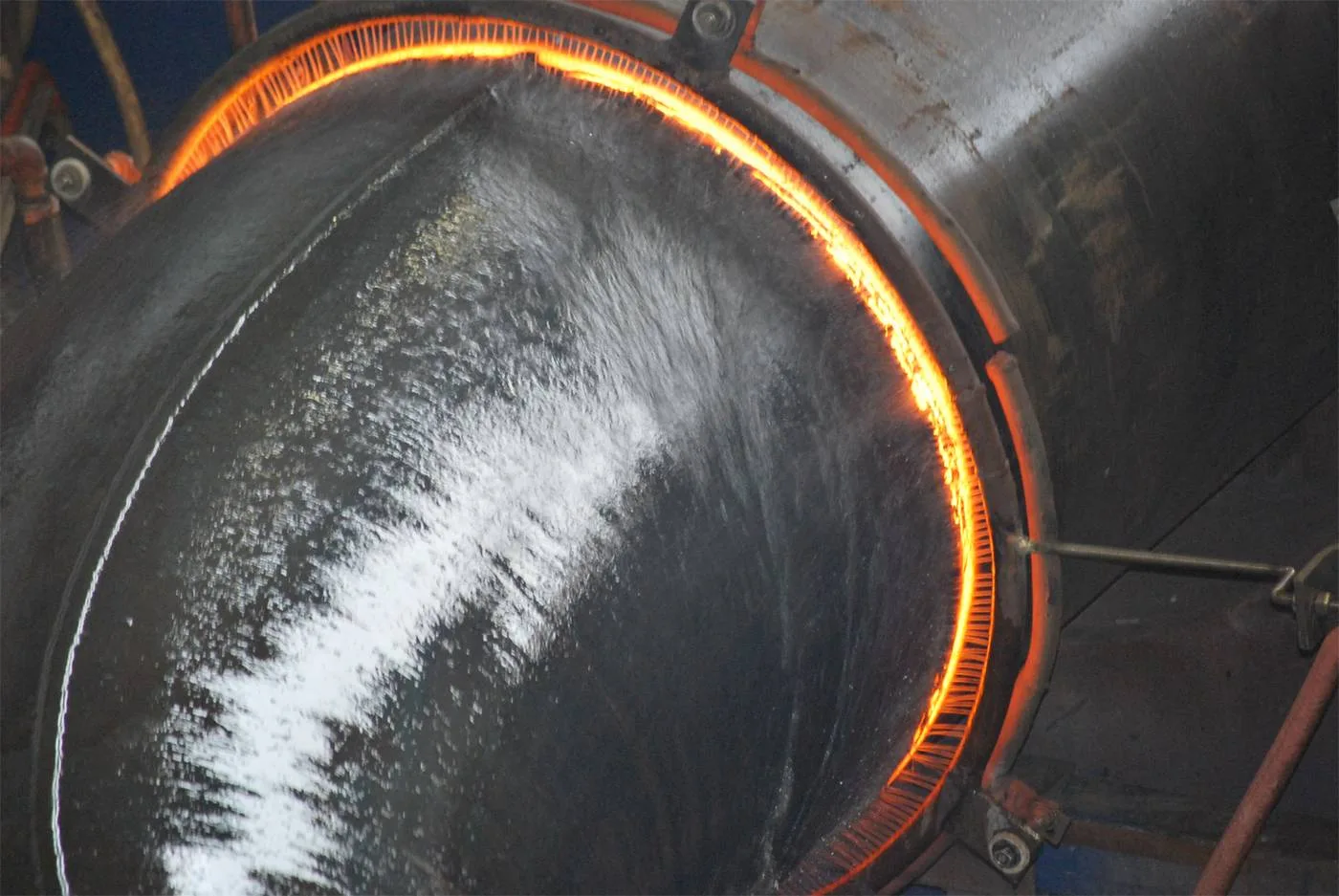
There is a point past which no internal tooling saves a bend. Once the wall is heavy relative to the diameter and the radius is tight relative to both, the metal has to be soft before it will move, and that means heat. At that point the job belongs on the induction bender, where a narrow heated band does the work a mandrel cannot.
Large diameter is the other boundary. Mandrel tooling is made per size, and above a certain point the mandrel itself becomes the difficult part. Our large-bore work goes through induction for that reason.
What to send, and what it costs to leave out
Five numbers describe a bend: outside diameter, wall thickness, centerline radius, bend angle and the tangent length on each end. Add the material, the quantity and the code and the job can be priced. The quote form takes a drawing up to 25 MB in PDF, DWG, DXF, JPG or PNG, and a photograph of a marked-up print is fine.
The things most often left out are the ones that change the price most. Documentation is the first: material test reports, non-destructive testing and heat treatment all have to be priced and scheduled from the start, and retrofitting a package onto a finished bend is slow and sometimes impossible. The delivery date is the second, because it decides whether the job is possible rather than what it costs.
The third is the acceptance criteria. Wall thinning on the outside of the arc and ovality through it are the two numbers a reviewer checks first. Tell us the limits and we will confirm the tightest radius that holds them before anything is cut. Finding the boundary at quote stage costs nothing; finding it at first article costs a length of pipe and a week.
Where a drawing calls out a bend that cannot be made as dimensioned, you will hear about it at quote stage rather than at delivery. That happens more often than it should, usually because an isometric was drawn without a bend schedule and the radius was never checked against the wall. Working back from an isometric to the five numbers each bend needs is routine here, and it normally catches at least one dimension that does not close.
Testing we can provide
Per your bending specification, not ours. Tell us the code and the acceptance criteria and we will say what runs here and what is subcontracted.
Other ways we bend
Wall thickness, radius, material and schedule decide the method. If you are not sure which fits, send the drawing and we will tell you.
Heat Induction Bending
Cojafex induction bending up through 42″ O.D. and 4″ wall, in any radius, angle or plane.
Read moreCoiling
Helical, spiral wound and serpentine coils, cold, up through 10″ pipe.
Read moreCold Bending
Rotary draw bending on fourteen machines, with mandrels and wiper shoes where the radius needs them.
Read moreLarge Diameter Pipe Bending
The work most shops turn away: up to 42 inch outside diameter and 4 inch wall.
Read moreStainless and Alloy Bending
Stainless, duplex, Hastelloy, titanium and nickel alloys, bent without wrecking the metallurgy.
Read moreCustom Pipe Fabrication
Cutting, end prep and fabrication around the bend, so one purchase order covers the package.
Read more
Have a drawing? Send it over.
Send a drawing or a sketch and our team will get back to you with a quote.