Pipe Bending for Industrial Heating and Cooling
Heat exchanger coils, process heater elements and the serpentine runs that move heat inside a fixed envelope.
What heating and cooling work brings to a bending shop
Shell and tube exchanger bundles, process heater coils, serpentine panels, chiller and condenser runs, and the return bends inside them.
Heat transfer equipment is the clearest case for coiling rather than bending. The design problem is always the same: fit as much tube surface as possible inside a fixed shell. Helical, spiral wound and serpentine are three answers to that, and this shop makes all three, up through 10 inch pipe cold.
Codes and standards: ASME Section VIII where the exchanger is a pressure vessel, TEMA on the exchanger itself, and B31.3 on the connected piping. Send your project specification with the enquiry and we will confirm in writing what we certify against before anything is cut.
What a coil drawing has to say
A coil takes more description than a bend. Along with the pipe size, wall and material, we need the coil diameter, the pitch, the number of turns, the number of passes and where the inlets and outlets have to land.
If the coil has to fit inside something, send that dimension and say whether it is hard. It is common for a coil drawing to specify a pitch that will not physically wind in the material chosen, and that is much cheaper to find at quote stage than after the first turn.
What to send with a heating and cooling enquiry
Five numbers describe a bend: outside diameter, wall thickness, centerline radius, bend angle and the tangent length on each end. Add the material and the quantity and the job can be priced. A drawing, a sketch or a photograph of a marked-up print all work, and the quote form takes an attachment up to 25 MB.
For heat transfer work, send the envelope the coil has to fit as well as the coil itself. Pitch, turns, passes and outlet positions describe the part; the shell or the frame describes the constraint. It is common for a coil drawing to specify a pitch that will not physically wind in the material chosen, and that is far cheaper to find at quote stage.
Put the documentation requirements in the enquiry rather than in a later email. Material test reports, non-destructive testing and heat treatment all cost money and time. Retrofitting a documentation package onto a bend that has already been made is slow, and sometimes it is impossible.
Materials we bend
If the grade you need is not listed, ask. This is what comes through most often, not a limit.
What we can bend for you
How we would make it
Wall thickness, radius, material and schedule decide the process. Send the drawing and we will tell you which one fits.
Heat Induction Bending
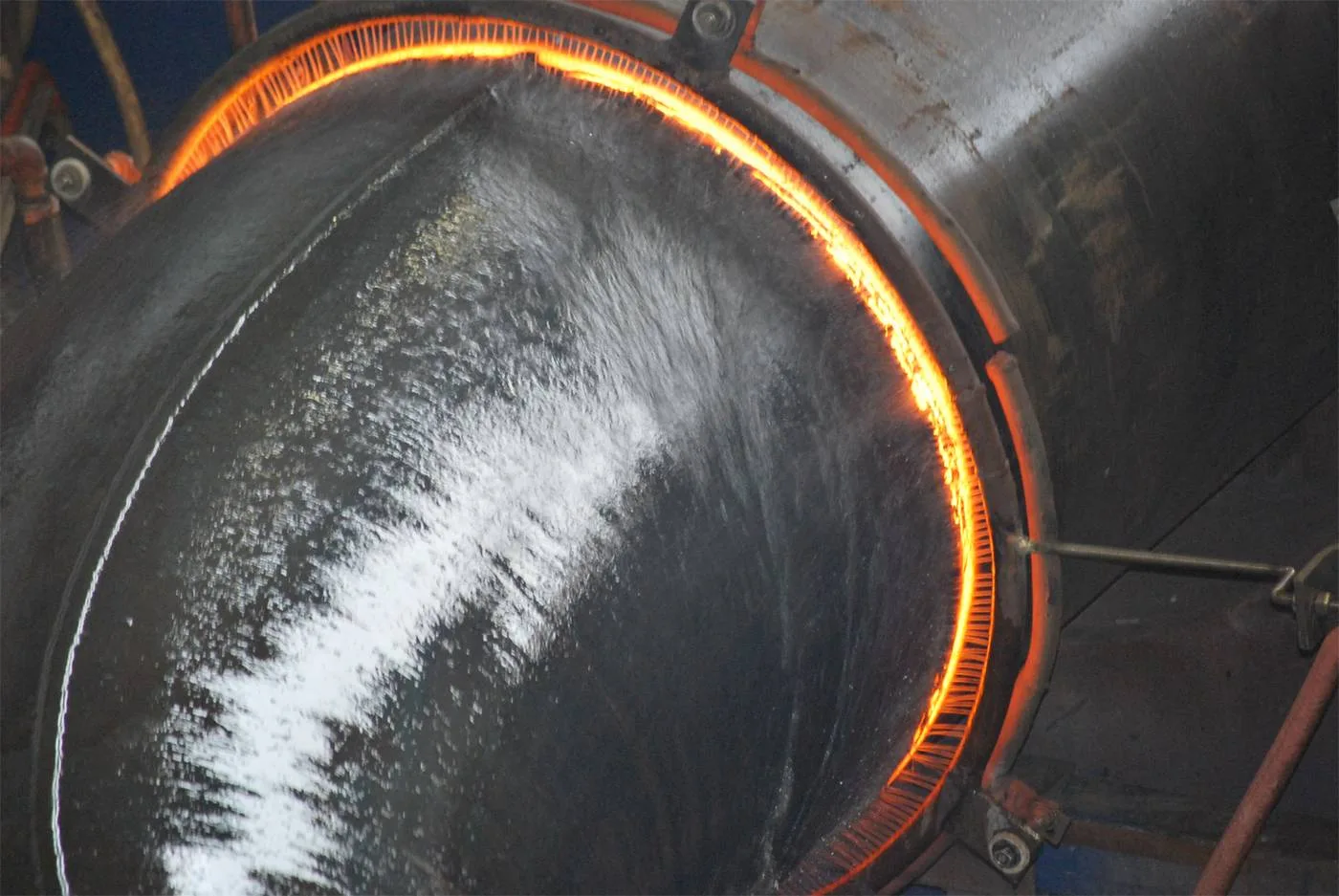
Cojafex induction bending up through 42″ O.D. and 4″ wall, in any radius, angle or plane.
Read moreCoiling
Helical, spiral wound and serpentine coils, cold, up through 10″ pipe.
Read moreCold Bending
Rotary draw bending on fourteen machines, with mandrels and wiper shoes where the radius needs them.
Read moreMandrel Bending
Ball mandrels and wiper shoes for tight radii and thin walls that would otherwise collapse.
Read moreLarge Diameter Pipe Bending
The work most shops turn away: up to 42 inch outside diameter and 4 inch wall.
Read moreStainless and Alloy Bending
Stainless, duplex, Hastelloy, titanium and nickel alloys, bent without wrecking the metallurgy.
Read moreQuestions we get from heating and cooling buyers
What coil types do you make?
Helical, spiral wound and serpentine, plus others to your drawing. Eight multi-pass helical coils and a six multi-wound coil with six outlets have been built here.
How large a coil can you wind?
Cold, up through 10 inch pipe, which is the largest cold coiling capability we know of in the industry.
Can you make return bends for an exchanger bundle?
Yes. Tight-radius return bends on tube are cold bending work, with mandrels and wiper shoes where the wall and radius need them. Send the tube size, wall and centerline radius.
Have a drawing? Send it over.
Send a drawing or a sketch and our team will get back to you with a quote.