Frequently Asked Questions
What buyers ask before they send a drawing, answered plainly.
Capacity and capability
What is the largest pipe you can bend?
Up to 42 inches outside diameter with a wall thickness up to 4 inches, on the Cojafex electric heat induction bender. Very few shops in the United States bend at the top of that range.
What is the smallest?
Half inch outside diameter in 16 gauge, on the cold bending machines. The full range runs from there to 42 inch O.D.
What size pipe can you coil?
Cold, up through 10 inch pipe, in helical, spiral wound and serpentine configurations. The shop has built eight multi-pass helical coils and a six multi-wound coil with six outlets, in sizes including 7 inch and 9 inch.
Can you bend shapes other than round pipe?
Yes. Channel, angle, wide flange, and round and finned tube. Tell us which axis you want bent about, because a structural section behaves completely differently about its strong axis than about its weak one.
What materials do you bend?
Stainless steel, carbon steel, copper, brass, aluminum, chrome, titanium, Hastelloy, Alloy 6XN, 2205 duplex and nickel-bearing alloys, among others. Material changes how a section behaves under both heat and draw, so send the grade rather than the family.
How tight a radius can you bend?
It depends on the diameter, the wall and the material together rather than on any one of them. Send all three and we will tell you the tightest centerline radius that holds your wall thinning and ovality limits.
Choosing a process
What is the difference between induction bending and cold bending?
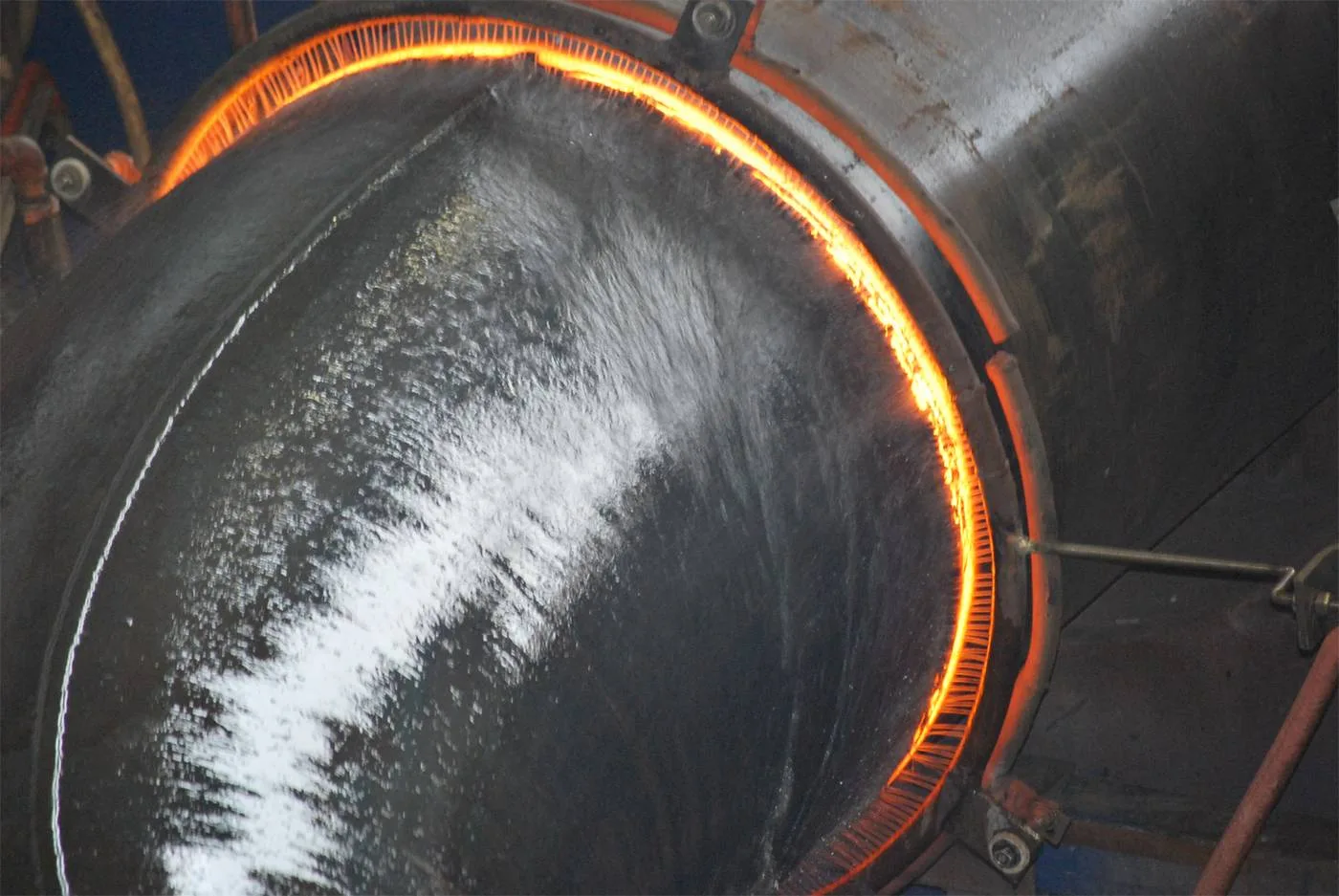
Induction bending heats a narrow band of the pipe wall with an induction coil so the metal moves without thinning, which is what makes large diameters and heavy walls possible. Cold bending forms the section around a die at room temperature, which is faster and cheaper on smaller sizes but limited by how far the wall will stretch before it collapses.
Do I need mandrel bending?
Usually where the wall is thin relative to the diameter and the radius is tight. A ball mandrel supports the wall from inside through the tangent point so the section does not flatten. Send the outside diameter, the wall and the centerline radius and we will confirm.
Does induction bending change the metallurgy?
It applies heat, so it can. Controlled cooling by air or water spray after the coil is the step that manages it, and the rate is chosen for the material. Tell us the material specification and the post-bend properties you need and the heat treatment can be quoted with the bend.
Can you bend more than one plane in a single pipe?
Yes. On the induction bender the radius, angle and plane are set per bend, so one length can be bent through several planes. That is usually the point: every bend that goes in is a butt weld that comes out.
When is a coil the right answer instead of bends?
When the job is to move heat. If the design problem is fitting as much tube surface as possible inside a fixed shell, it is a coil, and it needs pitch, turns, passes and outlet positions rather than a bend angle.
Codes, testing and paperwork
Is American Pipe Bending an ASME code shop?
Yes, holding the U and S stamps for Section VIII and Section I work. American Pipe Bending, Inc. is listed in the National Board Manufacturer and Repair Directory.
What piping codes do you work to?
ASME B31.1 for power piping, B31.3 for process, B31.4 for liquid transportation and B16.49 for factory-made induction bends, along with A.N.S.I., A.W.W.A., PFI-ES24 and MSS-SP75.
What non-destructive testing can you provide?
X-ray, liquid penetrant, magnetic particle, ultrasonic, Magnaflux, Brinell hardness, PMI positive material identification, elemental analysis and hydrostatic testing, along with heat treatment and stress relieving. Your specification decides which apply.
Do you heat treat in house?
Yes. In-plant stress relieving equipment is on the floor, so a part that needs it does not leave the building and come back. That removes a transport leg and usually several days from a schedule.
How is wall thinning on a bend verified?
Ultrasonic wall thickness readings along the extrados, compared against the limit in your specification or in ASME B16.49. Send the acceptance limit at quote stage.
Can you work to our own specification rather than a code?
Yes. Send it with the enquiry and we will confirm in writing what we can certify against before anything is cut, including where a requirement sits outside what this shop does.
Quoting, lead time and shipping
What do you need to quote a bend?
Five numbers: outside diameter, wall thickness, centerline radius, bend angle and the tangent length on each end. Add the material, the quantity and any code or specification and it can be priced.
What file formats can I send?
PDF, DWG, DXF, JPG and PNG, up to 25 MB through the quote form. A photograph of a marked-up print works too.
How quickly do you reply?
Enquiries are answered the next business day. The shop runs Monday to Friday, 5:00 AM to 3:00 PM Central.
Where do you ship?
Worldwide. The plant is less than 15 miles from the Tulsa Port of Catoosa, the furthest inland international port in the United States, so work leaves by highway or by barge depending on its size.
Do you take residential work?
No. This is a business to business shop. Customers are engineering and construction contractors, pipe fabricators, plant maintenance groups, boiler makers, shipyards and transportation contractors.
Is there a minimum order?
Send the enquiry and we will tell you. A single large-bore bend and a production run of four hundred small ones are both normal here, and the economics are different for each.
Terms buyers ask us to explain
What is centerline radius?
The radius of the arc measured to the middle of the pipe, not to the inside or the outside face. It is usually written as a multiple of the diameter, so a 3D bend on 12 inch pipe has a 36 inch centerline radius. Confusing it with the inside radius is the most common error on an incoming enquiry.
What is a tangent?
The straight length left on each end of a bend. It matters for two reasons: the machine needs something to grip, and the tangent is usually where the weld goes. A drawing that dimensions a bend with no tangent is describing something nobody can make.
What are the extrados and the intrados?
The extrados is the outside of the arc, where the wall stretches and thins. The intrados is the inside, where it compresses and can wrinkle. Wall thinning limits in a specification are almost always about the extrados.
What is ovality?
How far out of round the pipe goes through the bend, usually expressed as a percentage of the diameter. It is one of the two numbers a reviewer checks on an induction bend, the other being wall thinning, and ASME B16.49 sets the limits for both.
What is a plastic hinge?
The narrow band of softened metal the induction coil creates as it travels along the pipe. Only the metal inside that band moves, which is what lets a large heavy-wall section bend without the whole thing collapsing. The band travels with the coil, so the bend forms continuously.
What is a wiper shoe?
A tool that sits hard behind the bend die on a cold bending machine and irons out the wrinkle that would otherwise form on the inside of the arc. On a thin wall at a tight radius it is the difference between a bend and a scrapped length of pipe.
What is an out-of-plane bend?
A second bend in the same length of pipe that turns in a different plane from the first, so the pipe leaves the flat. American Pipe Bending makes single and multiple out-of-plane bends, cold and by induction. On the induction bender it is the feature that lets a whole spool be bent from one length rather than welded from several.
What is stress relieving?
A controlled heat cycle that lets the residual stress out of a part without changing anything else about it. Bending locks stress into the wall, and depending on the material and the service, a specification may require it to be relieved. In-plant stress relieving equipment is on the floor here.
Have a drawing? Send it over.
Send a drawing or a sketch and our team will get back to you with a quote.