

Capabilities
Roll Bending
Large-radius bends formed by passing the section through three rolls.
Where roll bending fits
Roll bending forms a large-radius curve by feeding the section between three rolls and closing them progressively. It is the method for long, sweeping radii, the kind that a rotary draw machine cannot reach because the die would have to be enormous.
It is common on structural sections and on handrail, architectural and tank work, where the radius is measured in feet rather than in multiples of the diameter. A full circle is the extreme case: a ring rolled from straight pipe, closed with one weld, rather than fabricated from segments.
The clearest example on this site is the transmission structures project: 6, 10 and 14 inch pipe rolled into large-radius circular frames, then fitted with the saddles and attachment points the decorative components hang from. Send the section, the radius and the material and we will tell you whether it rolls.
What was rolled for the transmission structures
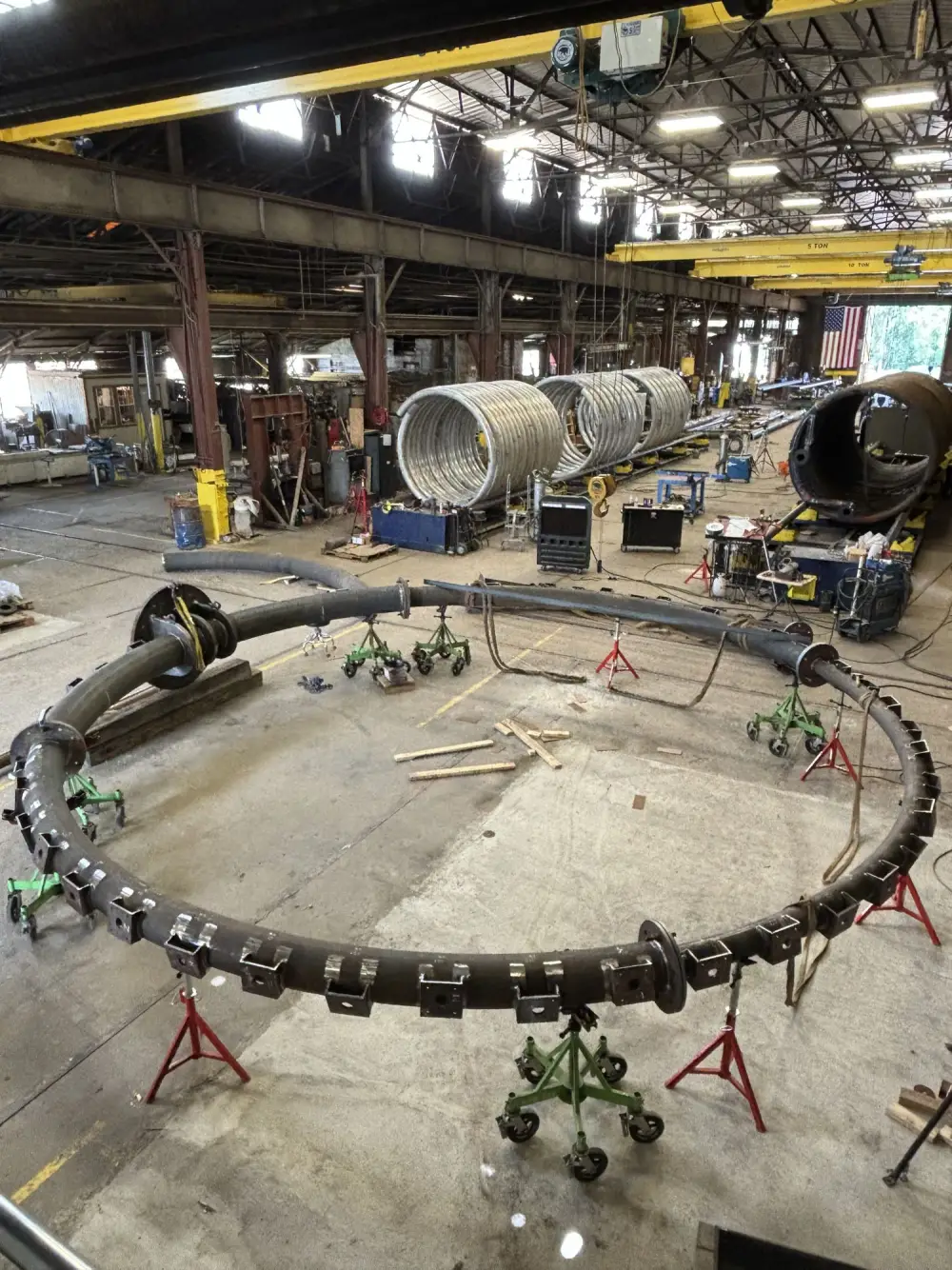
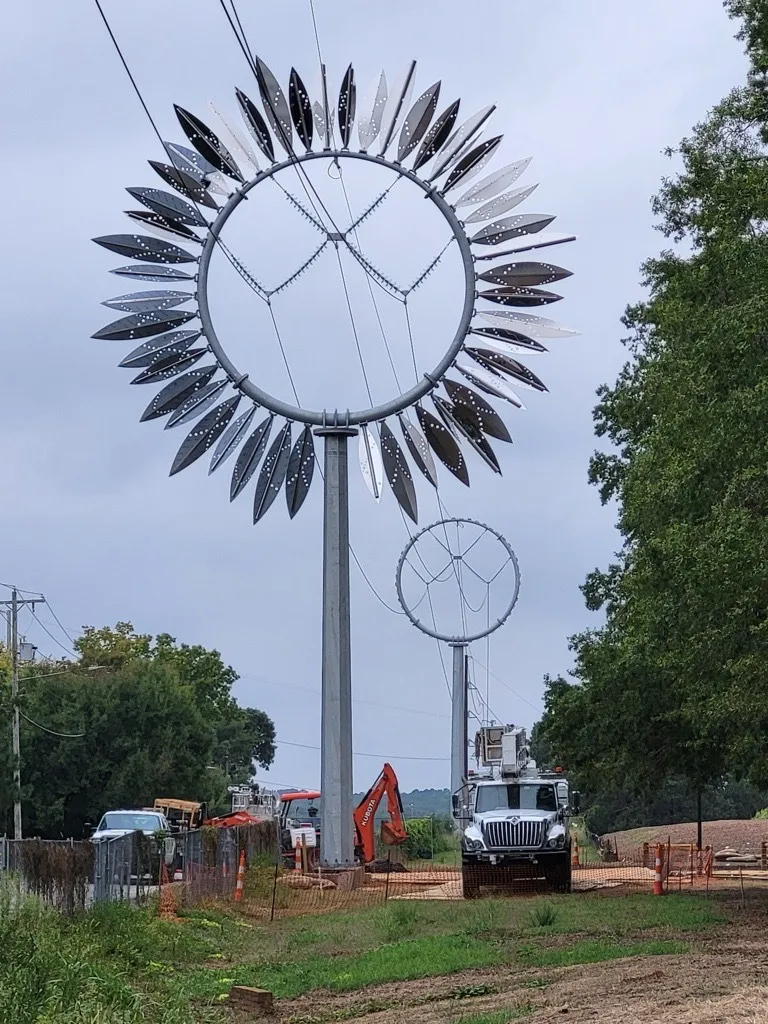
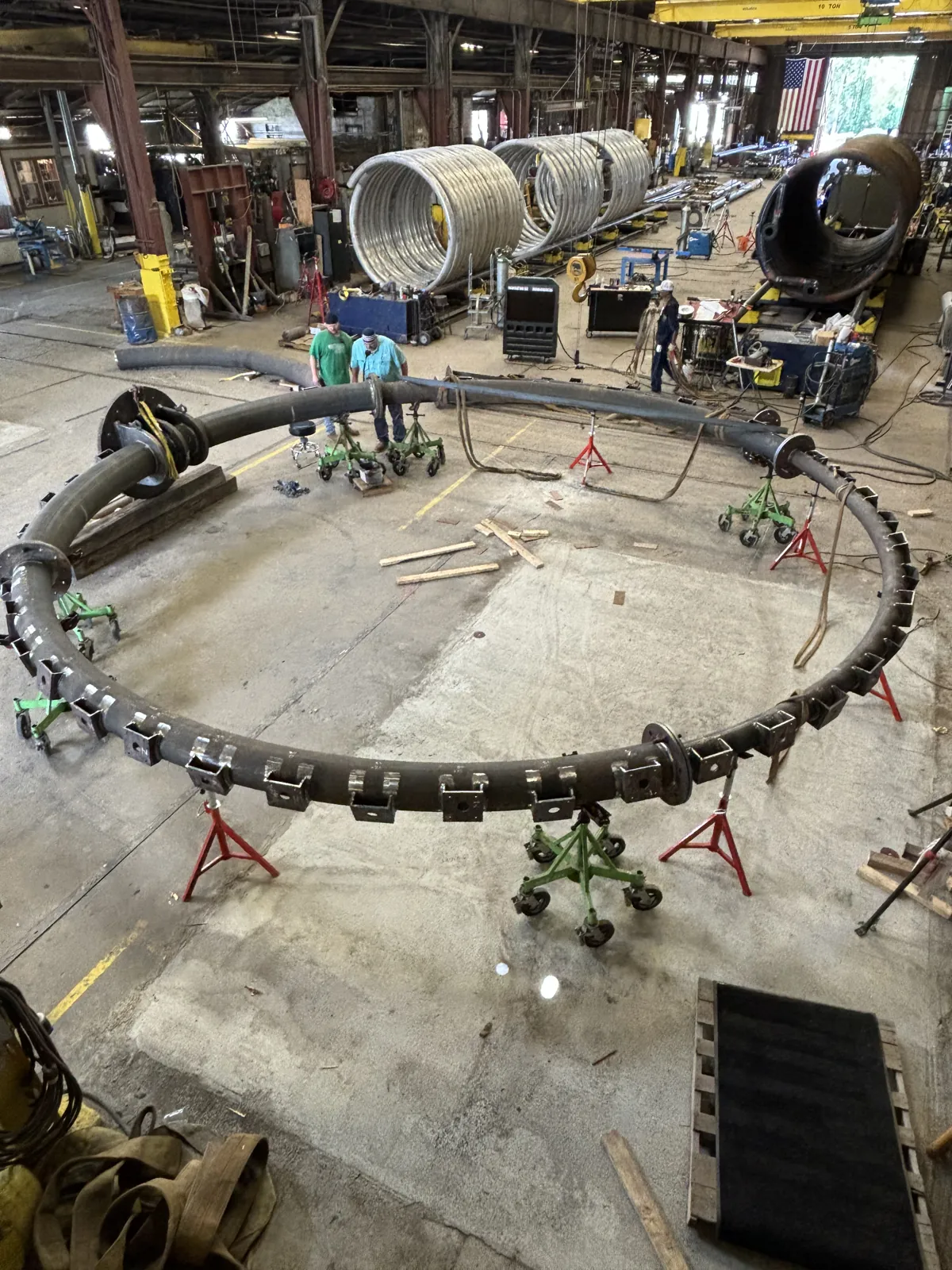
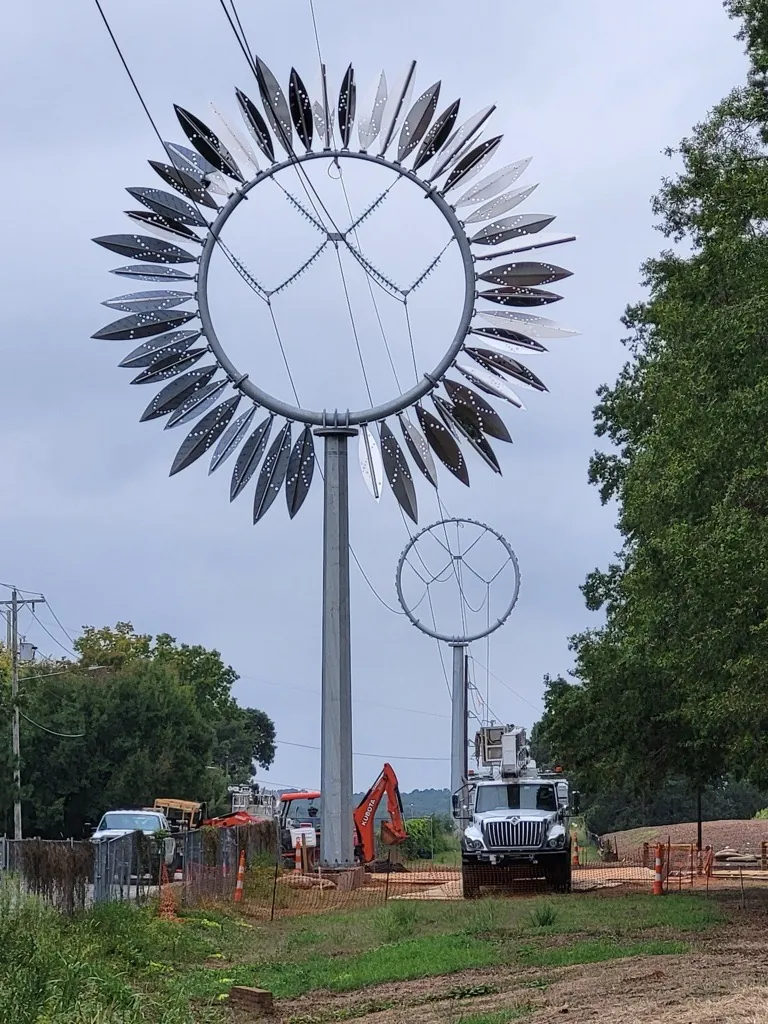
The sunflower-shaped transmission structures on the gallery page are the clearest example of roll bending on this site. Their primary structural framework is a set of large-radius circular components rolled from 6 inch, 10 inch and 14 inch pipe, with the decorative petal blades hung off fabricated saddles around the ring.
Rolling was only the first operation. After the rings were formed, the shop fabricated and installed the numerous custom saddles and attachment points the decorative components and the field assembly needed. Holding the geometry of a large rolled circle while positioning those attachments accurately was what decided whether everything fitted when the structures reached the field, and the scope ran from pipe forming through fabrication and shop completion.
That sequence, roll then fabricate on the same floor, is the practical reason to send this kind of work here rather than to a rolling shop and a fabricator separately: one drawing set, one schedule, and one place responsible for fit-up.
What to send for a rolled section
Send the section and its size, the material, the radius or the finished diameter, and whether the piece is a segment or a closed ring. For a structural section say which axis is being rolled about, because a channel or a wide flange behaves very differently about its strong axis than about its weak one.
If attachments are being fitted afterwards, send their positions with the inquiry rather than after the rolling, because holding a rolled radius while welding to it is a sequencing question that is far easier to answer before the first pass.
Off the floor
What to send, and what it costs to leave out
Five numbers describe a bend: outside diameter, wall thickness, centerline radius, bend angle and the tangent length on each end. Add the material, the quantity and the code and the job can be priced. The quote form takes a drawing up to 25 MB in PDF, DWG, DXF, JPG or PNG, and a photograph of a marked-up print is fine.
The things most often left out are the ones that change the price most. Documentation is the first: material test reports, non-destructive testing and heat treatment all have to be priced and scheduled from the start, and retrofitting a package onto a finished bend is slow and sometimes impossible. The delivery date is the second, because it decides whether the job is possible rather than what it costs.
The third is the acceptance criteria. Wall thinning on the outside of the arc and ovality through it are the two numbers a reviewer checks first. Tell us the limits and we will confirm the tightest radius that holds them before anything is cut. Finding the boundary at quote stage costs nothing; finding it at first article costs a length of pipe and a week.
Where a drawing calls out a bend that cannot be made as dimensioned, you will hear about it at quote stage rather than at delivery. That happens more often than it should, usually because an isometric was drawn without a bend schedule and the radius was never checked against the wall. Working back from an isometric to the five numbers each bend needs is routine here, and it normally catches at least one dimension that does not close.
Testing we can provide
Per your bending specification, not ours. Tell us the code and the acceptance criteria and we will say what runs here and what is subcontracted.
X-Ray
Liquid Penetrant
Magnetic Particle
Ultrasonic
Brinell Hardness
PMI (Positive Material Identification)
Elemental Analyzer
Hydro Test
Heat Treatment
Stress Relieving
Explore our capabilities
Wall thickness, radius, material and schedule decide the method. If you are not sure which fits, send the drawing and we will tell you.
Heat Induction Bending
Large diameter, heavy wall and specialty bending.
Read moreCold Bending
Rotary draw bending with extensive tooling and mandrel capabilities.
Read moreCoiling
Helical, spiral-wound, serpentine and custom coil configurations.
Read moreLarge Diameter Bending
Pipe bending capabilities through 42" O.D.
Read moreStainless & Alloy Bending
Experience across stainless, duplex, nickel alloys, titanium and specialty materials.
Read moreCustom Pipe Fabrication
Bending, welding, cutting, end preparation, testing and assembly.
Read more
Have a drawing? Send it over.
Send a drawing or a sketch and our team will get back to you with a quote.